Preview · Page 1 of 2
Meet the Book
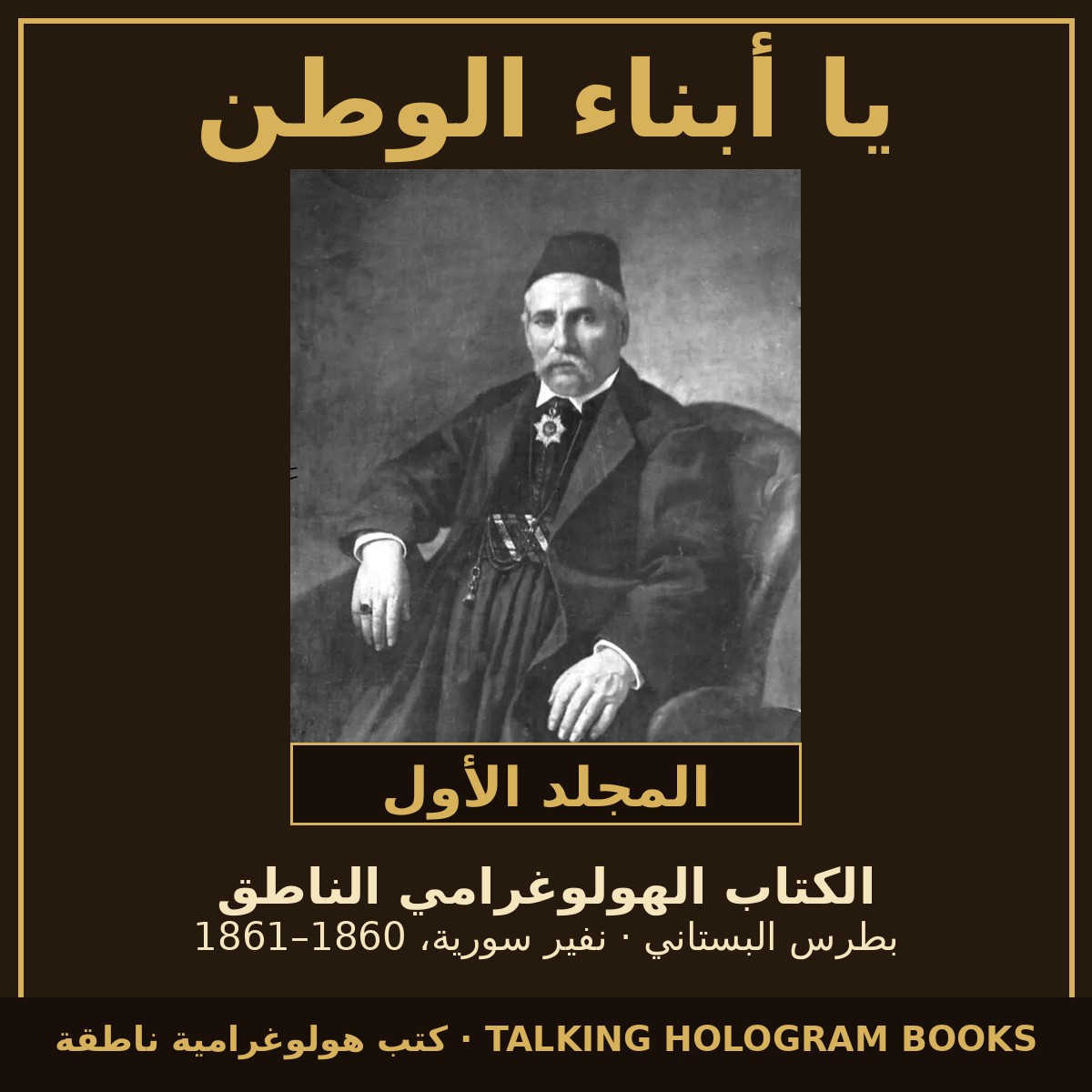
هذا هو مسرح الكتاب نفسه: المعلّم بطرس البستاني — بصورته المرسومة سنة 1884 — يقف على المسرح، وكتابه يُقرأ كاملاً بصوت عربي، بصوت كريم. في شتاء ١٨٦٠–١٨٦١، وعلى رماد الحرب الأهلية في جبل لبنان، كتب البستاني إحدى عشرة نشرة وعلّقها على جدران بيروت، يخاطب فيها أبناء الوطن الواحد فوق الطوائف كلها، ووقّعها باسم واحد: «محبّ للوطن». باركود المكتبة في كل إطار — امسحه في أي لحظة لتعود إلى هذه المكتبة.
This is the book's own stage: al-Muʿallim Butrus al-Bustani — the Teacher, in his portrait of 1884 — stands on the stage while his book is read aloud in Arabic, in Kareem's voice. In the winter of 1860–61, on the ashes of Mount Lebanon's civil war, al-Bustani wrote eleven pamphlets and posted them on the walls of Beirut, calling the sons of one homeland above every sect, and signed them with a single name: "one who loves his country." The bookstore barcode rides every frame — scan any moment to come back to this bookstore.
Press Next to see everything that is inside the whole book.
Preview · Page 2 of 2
What’s Inside
- Nafīr Sūriyya, complete: all eleven pamphlets (September 1860 – April 1861) — نفير سورية — the Clarion al-Bustani posted on the walls of Beirut, in his own words only; the modern editor's additions are excluded.
- 4 hours 17 minutes of narration — Kareem reads al-Bustani's own book aloud in Arabic, page by page, in a reading room you can follow with your eyes, while the author's portrait stands on the stage.
- Two more of his addresses — the 1859 address «في آداب العرب» (On the Learning of the Arabs) and the 1849 lecture «تعليم النساء» (On the Education of Women), among the first calls for women's schooling in the Arab world.
- The barcode rides every stage frame — scan any moment to come back to this bookstore.
This is the public-domain text of Butrus al-Bustani's Nafīr Sūriyya (Beirut, 1860–61), with his address of 1859 and his lecture of 1849, presented as a talking hologram book in the author's own Arabic. Al-Bustani died in 1883, more than a hundred and forty years ago. The one surviving witness of the 1859 address ends mid-sentence; the book carries it as witnessed rather than splicing in an ending, and says so plainly in its opening disclaimer. The narration is a synthesized Arabic reading (Piper — Kareem) of those texts, made for this edition; the figure on the stage is al-Bustani's portrait of 1884, painted by Dawud Qurm. Volumes Two and Three carry Tannus al-Shidyaq's chronicle of Mount Lebanon, which al-Bustani himself corrected and published. Editor: Franklin Langston.
franklinlangston.gumroad.com/l/ztjiul

Point a camera at this barcode to come straight back to this bookstore — and pass it on.