Preview · Page 1 of 2
Meet the Book
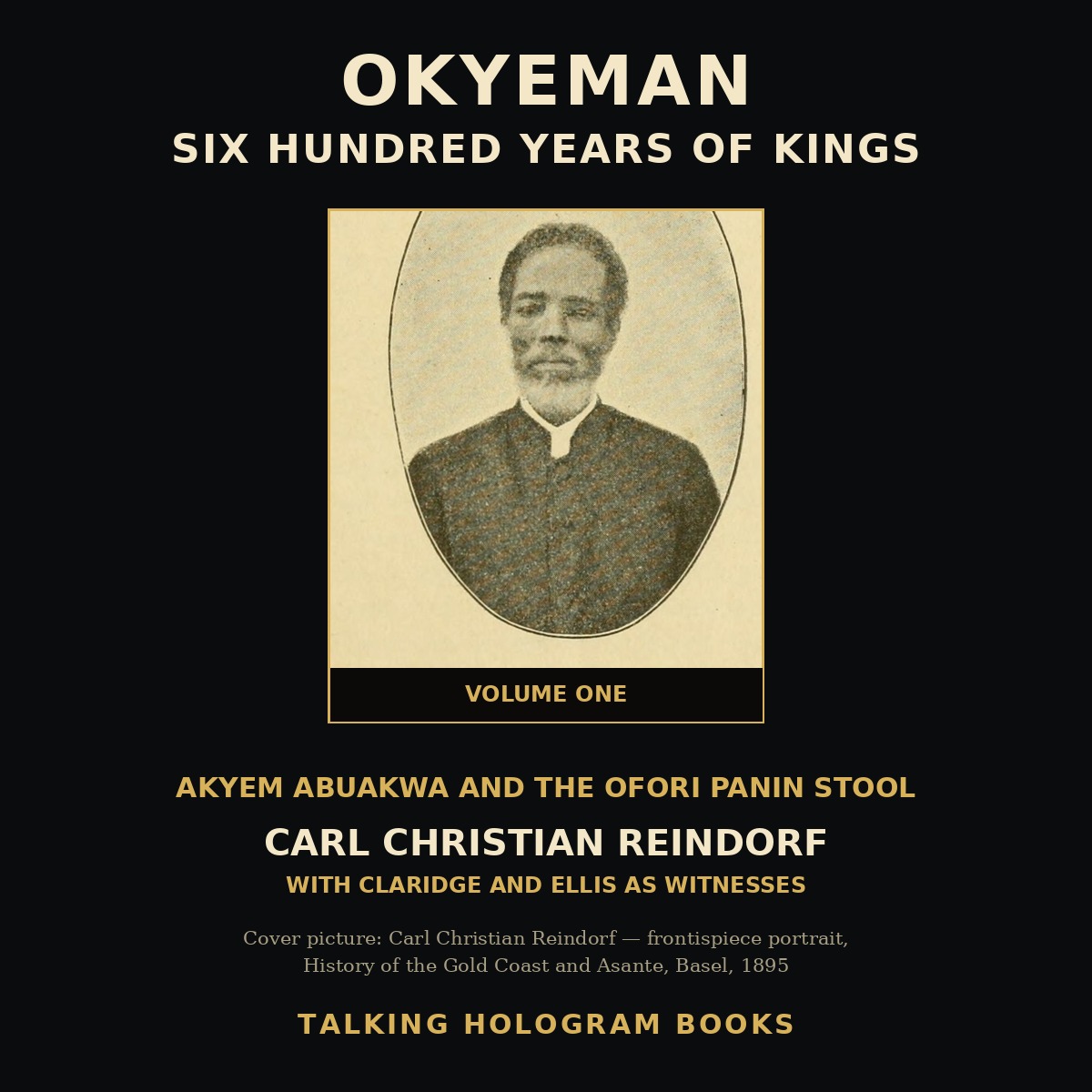
This is the book’s own stage: the portrait of Carl Christian Reindorf — the Ga historian of Accra who built his History of the Gold Coast and Asante (1895) from the testimony of more than two hundred witnesses of the old world — stands on the stage while his book is read whole, aloud: the founding of the kingdom of Akyem Abuakwa, the wars with Denkyira, the rise of Asante, and the victorious reign of Opoku Ware — with a plucked-string bed composed for this book playing low beneath the words. Two later historians, Claridge (1915) and Ellis (1887), stand apart as labeled witnesses in a second voice, so the testimonies never mix and the reader may weigh each one. The bookstore barcode rides every frame — scan any moment to come back to this bookstore.
Press Next to see everything that is inside the whole book.
Preview · Page 2 of 2
What’s Inside
- Reindorf’s chapters, whole: a Short Description of the Gold Coast, the Emigration and Settlements of the Tshi Tribes, Of the Kingdoms of Akwamu and Akem, the Warlike and Victorious Reign of Opoku Ware, and the Origin of Akuapem — every word as he printed it.
- 3 hours 41 minutes of narration — Reindorf read aloud in a clear man’s voice, and the witness chapters in a second voice, in a reading room you can follow with your eyes, while Reindorf’s portrait stands on the stage and the plucked-string bed plays low beneath.
- The book’s pictures — Reindorf’s own engraved plates from his History: Cape Coast Town and Castle, Chief Apea of Adwumako with his wife and court, and Christiansborg Castle after the earthquake of 1862.
- Two witnesses — Claridge (1915) on the early history of Ashanti and the years after Tutu, and Ellis (1887) on 1701–1750, each standing apart in a second voice, so the testimonies never mix.
- The barcode rides every stage frame — scan any moment to come back to this bookstore.
This book is gathered, not written: every narrated word belongs to its dead author — Reindorf’s History of the Gold Coast and Asante (1895), with Claridge (1915) and Ellis (1887) as witnesses. The youngest author, W. Walton Claridge, died in 1923; he passes the hundred-year rule by some three years, and the book states that margin plainly in its opening disclaimer rather than hiding it. Claridge wrote openly as a servant of the British Empire, and Reindorf from the standpoint of his own Ga people; both standpoints are named in the disclaimer. One courtesy governs the whole work: the kings of the last hundred years are carried by their stool names — the public names of their office — and no man’s private name is printed for them. The narration is a synthesized reading (Piper — Alan for Reindorf, Lessac for the witnesses) of those texts, made for this edition; the figure on the stage is Reindorf’s own portrait. Editor: Franklin Langston.
franklinlangston.gumroad.com/l/rkiixg

Point a camera at this barcode to come straight back to this bookstore — and pass it on.