Preview · Page 1 of 2
Meet the Book
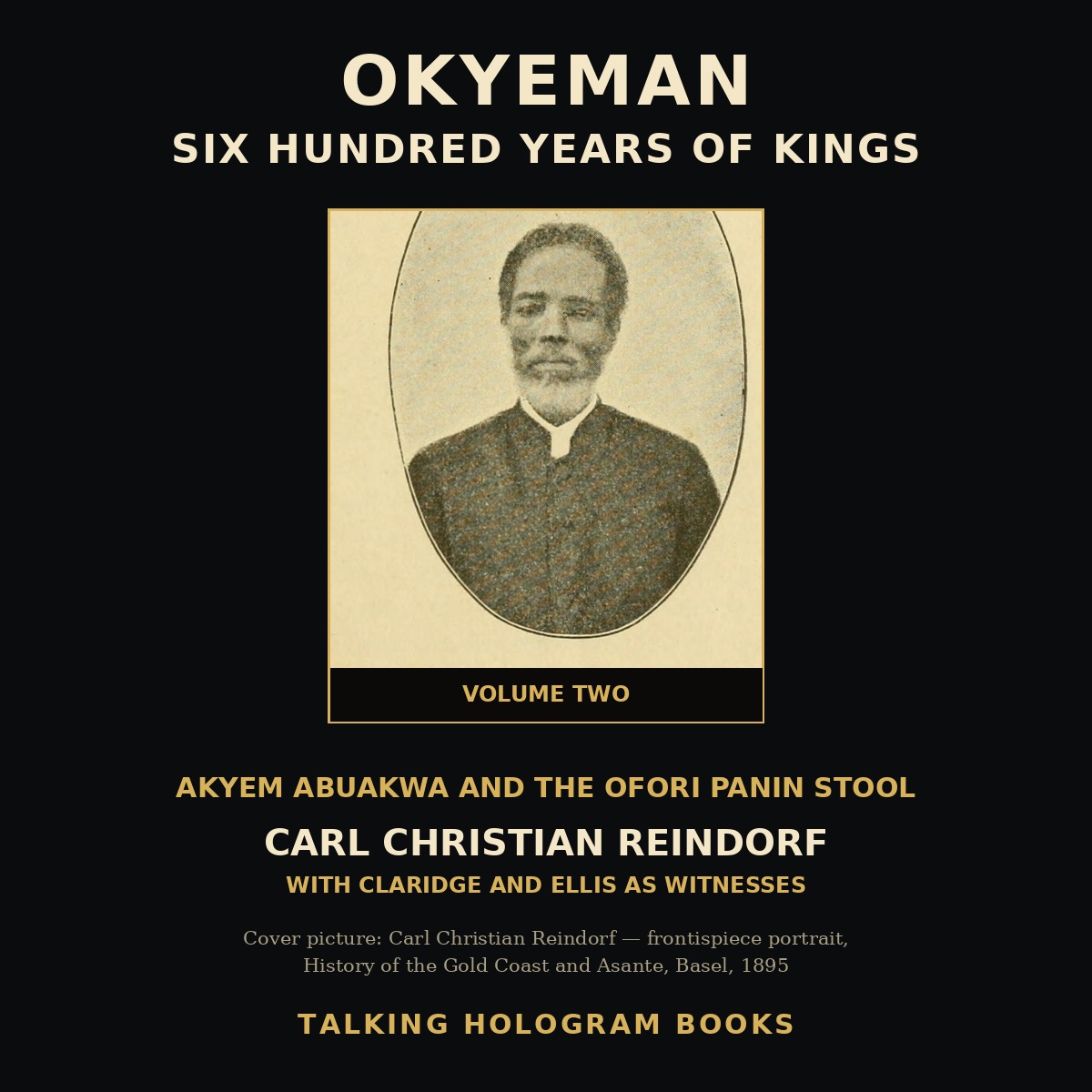
This is the book’s own stage: Reindorf’s portrait stands on the stage while the second volume of his History is read whole, aloud: the Asante revenge, the martial-law years, and the great battle of Katamansu — Dodowa — where Akyem and her allies broke an invasion — with Claridge (1915) standing as witness in a second voice. Then the book turns from what the kings did to the place itself: the Place Dossier on the royal stool and the law of succession — and at the back, the King’s Roll, every Okyenhene from the founder of 1365 to the present day, and a short publisher’s epilogue honoring the reigning king by his stool name. The bookstore barcode rides every frame — scan any moment to come back to this bookstore.
Press Next to see everything that is inside the whole book.
Preview · Page 2 of 2
What’s Inside
- Reindorf’s chapters, whole: the First Asante Revenge, Martial Law Proclaimed, the Causes Which Led to the Battle of Katamansu, Refuge for the Women and Children of Akem, the Battle and the Victory, Boaten’s Residence at Akem, and the Expedition Against Krepe — every word as he printed it.
- 4 hours 1 minute of narration — Reindorf, the Dossier, the Roll, and the Epilogue read aloud in a clear man’s voice, and the witness chapters in a second voice, while Reindorf’s portrait stands on the stage and the plucked-string bed plays low beneath.
- A witness — Claridge (1915) on Atta, King of Akim, in 1811, the War of 1873–74, and the country as he found it in 1902, standing apart in a second voice.
- The Place Dossier — from Reindorf and Ellis: the royal stool, the law of succession, the queen mother’s place, government, and the yam custom.
- The King’s Roll — every Okyenhene from the founder of 1365 to the present day, from the published lists, with the lists’ own disagreements printed rather than smoothed over — and a short publisher’s epilogue honoring the reigning Okyenhene, Osagyefuo Amoatia Ofori Panin, by his stool name and title.
- The book’s pictures — Claridge’s sketch map of the Ashanti War of 1874, his sketch map of Kumasi drawn after Reindorf, and Reindorf’s plate of the Basel missionaries.
- The barcode rides every stage frame — scan any moment to come back to this bookstore.
This book is gathered, not written: every narrated word of the history belongs to its dead author — Reindorf’s History of the Gold Coast and Asante (1895), with Claridge (1915) as witness. The youngest author, W. Walton Claridge, died in 1923; he passes the hundred-year rule by some three years, and the book states that margin plainly in its opening disclaimer. The narrated history ends where the printed record of the dead ends, in 1902. What comes after stands in two separate, labeled layers only: the King’s Roll, names and reign years from the published lists with their disagreements printed (the Ghanaian lists count the reigning king the thirty-fifth of his line; another published genealogy counts him thirty-fourth — both are given), and the publisher’s epilogue, in the publisher’s own voice, from sourced published facts. One courtesy governs the whole work: the kings of the last hundred years are carried by their stool names — the public names of their office — and no man’s private name is printed for them. No present-day dispute appears anywhere in this book. The narration is a synthesized reading (Piper — Alan for Reindorf, Lessac for the witnesses) of those texts, made for this edition; the figure on the stage is Reindorf’s own portrait. Editor: Franklin Langston.
franklinlangston.gumroad.com/l/cwmlla

Point a camera at this barcode to come straight back to this bookstore — and pass it on.